


Take a walk across the floor of a busy distribution center mid-season, and you know exactly what it looks like when a business starts bursting at the seams. Pallets of safety stock start creeping out of their taped-off zones. Forklift operators are suddenly squeezing through aisles that used to feel spacious. Before long, your loading dock isn’t a dock anymore—it’s a makeshift holding pen.
We all want growth. But sudden inventory surges—whether seasonal or due to an aggressive bulk buy—bring massive logistical headaches. When your physical square footage just can’t keep pace with your supply chain, you usually hit a wall. Do you lock yourself into a ridiculously expensive multi-year lease for an off-site facility? Or do you figure out a leaner, faster way to scale?

For plenty of modern supply chain directors and operations managers, the answer is literally sitting right out in the yard. Heavy-duty shipping containers are quietly becoming the secret weapon for companies needing immediate, secure space.
Here is exactly how you can leverage sea cans to solve your warehouse overflow problems, without destroying your operating budget in the process.
The Flaw in Traditional Commercial Storage
Let’s talk about traditional expansion for a second. It’s slow. It’s rigid. And man, is it expensive.
Say you hit a temporary inventory spike. Maybe you bought bulk raw materials to get ahead of inflation, or your Q4 holiday stock arrived three weeks early. Signing a restrictive lease for off-site commercial storage just to house a temporary surge rarely makes financial sense.
You end up eating the high cost per square foot, sure. But the real killer is the operational drag. Think about it: every time your team has to pull inventory from a secondary building across town, you’re burning gas, paying for double-handling of goods, and bleeding valuable labor hours.
Why do that when you can keep your inventory exactly where it belongs? Right on your own asphalt.
Why Shipping Containers are the Ultimate B2B Storage Hack
When we start looking at agile warehouse storage solutions, standard sea cans really sit in a category of their own. Think of them as modular, drop-in aisles. Add them when things get chaotic; pull them back when the cycle cools down.
Here’s why operations teams are making the pivot to steel containers:
- Zero Build Time: Forget zoning permits, unreliable contractors, and construction delays. A container drops into your yard and is ready to load that exact same afternoon.
- Capital Efficiency: Renting—or even buying—a unit is a drop in the bucket compared to commercial real estate. You scale up for the busy season and scale down when things normalize. It’s that simple.
- Ultimate Security: These aren’t flimsy aluminum sheds. We’re talking 14-gauge corrugated Corten steel. Slap a high-security lockbox over the doors, and they become basically impenetrable to vandals, keeping your high-value assets completely locked down.
Cost & Efficiency Breakdown: Off-Site vs. On-Site
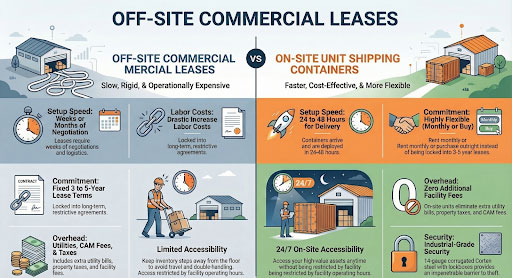
Want to see the actual operational impact? Let’s stack containerized storage up against a secondary commercial lease to see where the real savings happen.
|
Metric |
Off-Site Commercial Lease |
On-Site Shipping Container |
|
Setup Speed |
Weeks or months of negotiations and logistics |
24 to 48 hours for immediate delivery |
|
Commitment |
Locked into fixed 3 to 5-year lease terms |
Highly flexible (Rent monthly or purchase outright) |
|
Labor Costs |
High (Requires staff to travel and double-handle goods) |
Low (Inventory remains steps away from your main floor) |
|
Accessibility |
Limited strictly by the facility’s operating hours |
24/7 access on your own secure property |
|
Overhead |
Additional utilities, CAM fees, and property taxes |
Zero additional property taxes or facility fees |
Strategic Uses for Containerized Overflow
So, what does this actually look like in practice? The trick isn’t to just shove random boxes outside. The smart move is shifting low-velocity or seasonal items out of your primary building. That immediately frees up your premium indoor square footage for high-speed picking, packing, and fulfillment.
If you need practical storage containers for business applications, try moving these categories outside:
- 1. Seasonal Inventory and Promo Materials Retailers and distributors know the seasonal swap all too well. Don’t let patio umbrellas or winter snowblowers eat up premium racking for nine months of the year. Cycle out-of-season goods into a weather-tight box until you actually need them.
- 2. Raw Materials and Packaging Supplies Manufacturing floors get cluttered incredibly fast. Cardboard boxes, shrink wrap, packing peanuts, or raw steel and lumber—none of this needs to live right next to the assembly line. Stage it in a dry container just outside the bay doors to keep your active floor clear.
- 3. Equipment and Machinery Storage Landscaping crews, construction firms, and municipal fleets deal with bulky, expensive machinery that isn’t always in daily rotation. A ground-level sea can secures these assets from theft and bad weather while keeping the main shop wide open for maintenance work.
Setting Up Your Overflow Strategy
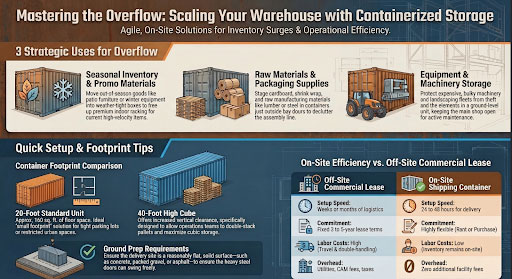
Ready to get your warehouse floor back? Rolling out a container strategy is surprisingly easy.
Start by taking a hard look at your yard. You just need a reasonably flat, solid surface—think concrete, packed gravel, or asphalt—so the heavy doors can swing freely. Then, figure out your footprint. A standard 20-foot unit gives you about 160 square feet of floor space, which slides perfectly into tight parking lots. Need more room? A 40-foot High Cube gives you the vertical clearance to double-stack pallets.
Stop letting inventory bottlenecks dictate your daily workflow. Start looking at your parking lot as an extension of your warehouse. It’s a faster, safer, and completely scalable way to solve your storage crisis—entirely on your own terms.
Conquering the Climate: Built for the Elements
Naturally, supply chain folks worry about putting inventory outside in a steel box. Will it survive the weather?
Remember what these things were built for in the first place. They spend weeks stacked on cargo ships, taking an absolute beating from saltwater, corrosive sea air, and hurricane-force winds. They are inherently wind and water-tight. Those heavy-duty rubber door gaskets simply don’t care about driving rain, snowdrifts, or rodents.
Whether you run a facility in a damp coastal zone, or you’re fighting the brutal, deep freezes that make rugged storage containers edmonton and prairie businesses rely on an absolute necessity, Corten steel does the job.
And you don’t have to settle for an empty metal shell, either. If you’re dealing with temperature-sensitive inventory like electronics, liquids, or pharmaceuticals, you can trick these units out. Add spray-foam insulation, bolt in a commercial HVAC system, or install heavy-duty pipe racking and LED lights. You can essentially clone a section of your indoor warehouse.
Honestly, basic overflow storage is just scratching the surface. To see how companies are transforming these things into mobile offices, field labs, and retail spaces, check out the massive variety of shipping containers uses out there right now.
Contact Secure Container Solutions today. Call: (647) 560-2745
Leave a Reply